Music for the day. KTHX (ONE)
Toni Varga – Fuck It (Betoko Remix)
Soulwax – NY Lipps (Kawazaki Dub)
Alter Ego – Baby Kraut (Original Mix)
kthx, l8r
Music for the day. KTHX (ONE)
Toni Varga – Fuck It (Betoko Remix)
Soulwax – NY Lipps (Kawazaki Dub)
Alter Ego – Baby Kraut (Original Mix)
kthx, l8r
Ableton have added a nifty sidechain feature to the Auto Filter plugin. This allows you to modulate your filtering with a routed signal. Just for kicks I’ve put together a little sample of what type of transition effects you can get using this tool.

Sample 1 — This is a couple of loops leading into a new track
Sample 2 — This is a series of 4 or 5 tracks (I forget) leading into one another using various sidechained filtering.
Everyone’s favorite leporid – bunnie – had a BBQ last evening, complete with ridiculously delicious bacon wrapped hot dogs, carne asada, and pot-stickers. Also booze and halo of course. Since I’m always looking for an excuse to sit down and prepare some tunes, I put together a mix for the occasion. Here’s the tracklist and the MP3 download.
V-Sag – Sacred Truth feat Tomomi Ukumori (Original Mix)
Phynn – Starfire at Night (Andy Duguid Remix)
Deepsky – Brambledog (Original Mix)
Distant Fragment, Steve Mill – Utopia (DJ Tarkan / V-Sag Remix)
Hook N Sling – Plastic Wrap (Original Mix)
Melleefresh, Deadmau5 – Attention Whore (Original Mix)
Andrew K – The Coriolis Effect (Simon Firth Remix)
PQM – You Are Sleeping (PQM Meet Luke Cable Vocal Pass)
I put together a quick mix to test some new production techniques. It came out pretty good, so I feel like there was some good progress this time around. These are some fun tracks, the new techniques let me put them together which would have been much more difficult before.
If anybody likes hearing these details, this is what I did differently this time around:
My holy grail at the moment is a method to decibel-histogram match (or at least, the ability to alter the dynamic range via histogram manipulation). I think this would be a very valuable tool. I’m exploring how this might be done with image processing tools on adobe audition’s export/import to BMP features.
Anyway, here’s the mix Caustik – Random 001.mp3.
Track List:
Seva K. – The Jungle of Music (Sebastian Davidson Mix)
Chris Lake + Trophy Twins – Babaloo (Original Mix)
Moonbeam – Sky (Vocal Mix)
Moonbeam – Seeming Reflection
Petter – All Together

At about 9pm last night, we spontaneously decided to drive up to Avalon, Hollywood to catch Hybrid. It was absolutely worth it, and then some.
The entire set by Hybrid was virtually perfection. The bass had to be hitting a 5 on the richter scale, literally. There were moments when you would physically feel sick from the bass, but you’d stay on the dance floor anyway because it was just too awesome.
Probably the only set I’ve witnessed that could compete with the first 30 minutes of Hybrid’s set is a performance by John 00′ Flemming at a rave last year. It’s pretty much physically impossible to not dance. I think the floor actually vibrates you into dancing against your will if you attempt to resist
We got home around 5:30am, and I was still awake enough to put together an interesting tweaking experiment. Hard to describe *exactly* what I was experimenting with, but it was basically piping multiple tracks to a 3rd channel, and applying EQ sweeps and delay FX, along with tweaks on the Xone’s HPF/LPF.
I cut the recording off shortly after the first completed transition, as it was certainly sleepy time!
Caustik – Experiments – tweaking1
Discovered a powerful heuristic for track selection which helps you to find track combinations that “work” very well together. “Mixing in key” is a fairly popular method for track selection. Basically you want to find tracks that are “compatible” in a musical way. I’ve found that following the circle of fifths either clockwise or counterclockwise, always skipping 3, leads to some really astonishing results.
Here’s an experiment, using counter-clockwise circle of fifths traversal on the song keys. Note that some tracks end in a different key than they start, so you always have to take that into account.
DW – Pillow feat Hannah (Discosynthetique & Miller Remix)
Tasadi, Mike Mikhjian – Zeus (Vadim Zukhov Remix)
DJ Polyakov PPK – Resurrection (VZ Remix)
Alex Young, Artech – Minimalesk (Original Mix)
Long Range – Just One More (Hybrid Mix)
V-Sag – Shakespearean Love feat Ukumori (Original Mix)
This mix starts out with a deep dark-ish DW track remixed by Discosynthetique & Miller, drops into the phenomenal and energetic “Zeus” track, followed by “Resurrection” which is one of my recent favorites.
After this, the mix crawls back down into the very dark and delicious “Just One More” Hybrid Mix, by way of “Minimalesk” — and tempo bends back out of the darkness into a nice V-Sag track “Shakespearean Love”.
The new technique of the week, which I used in every transition, is side chain compression between transitioning tracks. This, especially combined with EQ dodging, creates a back-and-forth rhythm between two tracks. Makes for some really interesting rhythm combination possibilities.
Interesting note — my intro into Pillow is taken from the scene in spaceballs where the huge space ship is slowly panning across the screen. Ran it through some reverb, resonance, and chorus FX and pitch altered.
The whole mix is mastered (the “easy” way) using iZotope Ozone 3, which is a phenomenal tool for mastering for those of us who haven’t spent 20 years learning how to do it the old fashioned ways.
I noticed one of the limiting factors in producing my own original electronic music tracks was my lack of the ability to generate a real melody.
So, I did an experiment where I took an existing Mozart Sonata, ripped out a simple progression, and created a simple track around that progression. The result is pretty interesting: Download MP3.
In addition to this, I read up a bit on chord progressions, and came up with a simple note progression and then build on top of that in a fractal fashion, and came up with this result: Download MP3.
It is interesting how fractal in nature music really is. From synthesizing sounds, to creating a melody, to creating a song with transpositions on that melody, to generating a mix of various songs — the principles remain very similar.
* Update: I was pretty hooked on this fractal concept, so I went ahead and created another track: Download MP3.
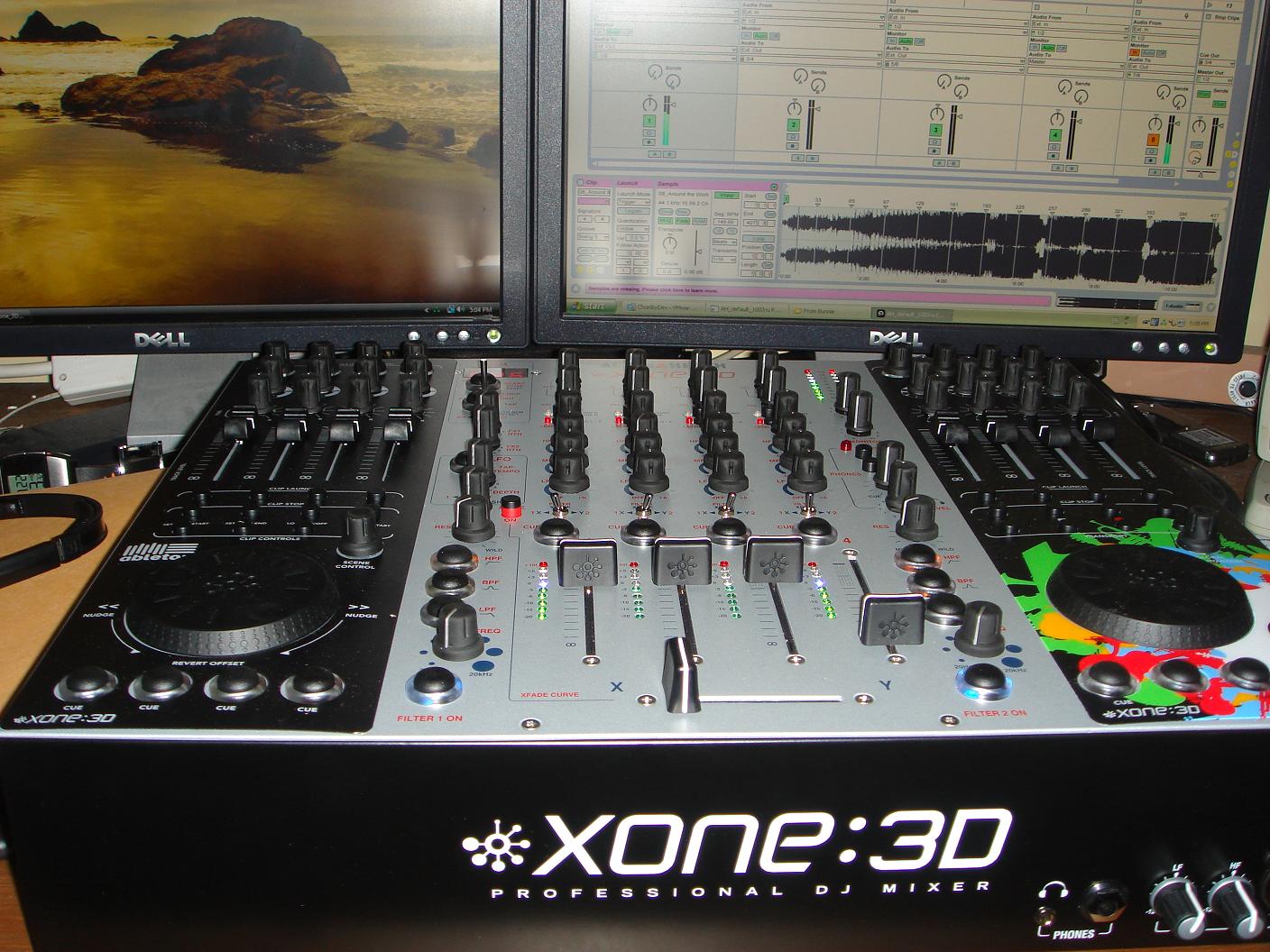
My new Xone:3D equipment arrived on Friday. Since then I have been spending a fair amount of my free time obsessing over it, learning all the features, and getting all the components properly pieced together.
The Xone:3D comes with custom face-plates specifically for Ableton Live (which is my DJ tool of choice). There is also a template available for download on the Allen & Heath web site. This template sets up all the configurations for a really great integration with Ableton Live.
The biggest difficulty I have had so far is the lack of Vista 64-bit drivers. Actually, I was unable to get the drivers loaded even on my Vista 32-bit laptop. So, for now, I am actually DJ’ing over remote desktop…as bizarre as that seems.
Current, I have 3 Ableton tracks mapped to 3 mixer inputs on the Xone 3D. From here I can use all the powerful A&H mixing and MIDI controls to manipulate the sounds in whatever ways I’d like. Later I will post some videos of mixer tricks I have figured out.
I then use ASIO4ALL and Ableton Live to wire the Xone 3D’s sound card output (Mix Output) to the sound output of a small USB sound card on my PC which is running over remote desktop. This allows me to hear and record the output of the mixer without having to use special hardware. In a gig scenario, this would instead pipe directly to the house stereo.
So I gotta say I really love this new setup and I can’t wait to see all the things that can be done with it. I will be posting more about this new equipment as I get more familiar with it.

Still experimenting with FruityLoops. I’ve learned a good deal about Sidechaining and ducking. I’m fairly satisfied with the over-all sound of the instruments blending in this track. Usually when listening to a track, one may not realize the amount of engineering effort that goes into a professional quality track. It is difficult to keep the instruments blended without interfering with one another.
That said, I am not exactly at professional level yet. But it’s good fun to learn, and in time it’ll get there.
 [
[  caustik's blog